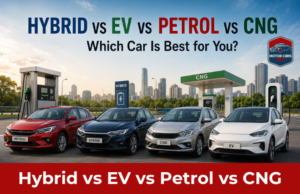
Diesel cars have always been popular among Indian buyers because of excellent fuel economy, powerful low-end torque and lower running costs. However, the Indian automotive industry has evolved significantly with the growth of petrol, CNG, hybrid, and EV options.
Is it still worth to purchase diesel cars in India in 2026?
The answer is yes – but only for the right buyer.
Diesel cars will still be a good option for those who drive long distances, frequent highway rides or are looking for a big SUV with strong torque.
For city drivers, a petrol, CNG, hybrid or EV may be a better choice and make more financial sense.
Everything depends on several factors such as annual mileage, purchase price, maintenance, driving conditions and so on.
Diesel Cars in India: Are Still Relevant?
Diesel’s contribution to the Indian passenger vehicle market has been on the decline over the years, but diesel is not dead. In July 2026, diesel contributed around 18% to passenger vehicle sales, while SUVs are still giving diesel engines a market.
The modern BS6 diesel engines have been much cleaner than older-generation diesel engines because of the use of technologies like Diesel Particulate Filter (DPF) and Selective Catalytic Reduction (SCR) in many models.
Torque and Acceleration Advantage
One of the biggest advantages of a Diesel engine is Torque. The Diesel engine is characterised by strong torque output at lower speeds. Therefore, this type of engine is particularly used for highway overtaking, climbing steep roads, carrying passengers & luggage and long-distance touring. The diesel SUV can easily cruise on highways and inclines without any problem.
Highway Performance
Diesel cars continue to be the perfect choice for highway users. A diesel SUV has enough torque and better fuel economy, which makes it travel long distances without stopping for refueling.
The most convincing evidence is the sustained popularity of diesel SUVs. SUVs such as the Mahindra Scorpio, Mahindra XUV 7X0, Hyundai Creta, Mahindra Thar, KIA Seltos, Tata Nexon and Innova Crysta all retain their appeal to diesel buyers.
In H1 2026, some diesel models saw double digit growth year-on-year.
Diesel still enjoys an efficiency advantage in many vehicles, especially for consistent highway driving. The combination of fuel efficiency, torque and highway efficiency is the core reason why diesel continues to matter.
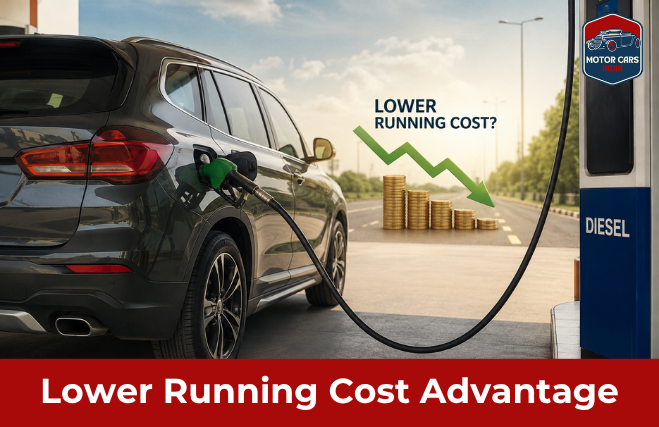
Running Cost Advantage of Diesel
Running Cost continues to be one of the biggest advantages of diesel.
Let us consider an example for illustration:
Assuming that a petrol car delivers 14Km/L while a diesel car delivers around 20 Km/L.
Using an illustrative price of approx. Rs. 102/L for petrol and Rs. 92/L for diesel, the approximate fuel cost would be
Running Cost = Fuel Price ÷ Real-world mileage
Petrol – Rs. 102 ÷ 14 = Rs. 7.28 Approx.
Diesel – Rs. 92 ÷ 20 = Rs. 4.6 Approx.
The difference is approximately Rs. 2.68 per kilometre.
At 10,000 km, it becomes more noticeable
At 20,000 to 30,000 km, the savings per year become significant.
However, these are just illustrative calculations. Actual fuel prices, real-world mileage and driving conditions will be quite variable.
| Annual Running | Petrol Cost | Diesel Cost | Diesel Savings |
|---|---|---|---|
| 10,000 km | Rs. 72,800 | Rs. 46,000 | Rs. 26,800 |
| 15,000 km | Rs. 1,09,200 | Rs. 69,000 | Rs. 40,200 |
| 20,000 km | Rs. 1,45,600 | Rs. 92,000 | Rs. 53,600 |
| 25,000 km | Rs. 1,82,000 | Rs. 1,15,000 | Rs. 67,000 |
| 30,000 km | Rs. 2,18,400 | Rs. 1,38,000 | Rs. 80,400 |
“The more you drive, the more valuable diesel’s fuel efficiency advantage becomes.”
DPF: The Biggest Diesel Ownership Consideration
The Diesel Particulate Filter (DPF) is certainly not something that consumers should fear, but rather something they should learn about.
Many modern BS6 diesel cars come with advanced emission control technology that minimises the amount of particulates emitted. One of the most important components is the Diesel Particulate Filter (DPF).
The DPF collects soot particles and requires regular regeneration at a sufficiently high temperature.
This is one of the reasons why diesel cars work better for users who drive long distances.
Who should still buy a Diesel car?
Buying a diesel car can be a wise decision if these criteria describe your usage:
- You drive 15,000 – 20,000 km or more annually
- You make frequent journeys from one city to another
- You spend much time driving on highways
- You want an SUV with strong torque
- The cost premium for a diesel is not too high versus its petrol model
- You understand the maintenance requirements of a modern diesel engine
Who should avoid buying a Diesel?
Use of petrol, CNG, hybrid or an EV may suit you better if:
- You travel less than 10,000 km in a year
- Your trips are mostly short
- You usually drive in city traffic
- You want the lowest purchase cost
- You prefer a smooth and quiet driving experience
- You do not want to deal with a diesel emission system
- Your city has restrictions that could affect long-term diesel ownership
- You intend to sell the car after a short ownership period
Diesel vs Petrol: Pros & Cons
Diesel Pros & Cons
| Diesel Pros | Diesel Cons |
|---|---|
| Better fuel economy | High purchase price |
| Strong low end torque | Higher maintenance cost |
| Excellent highway performance | DPF system consideration |
| Lower running cost | Less suitable for short trips |
| Well suited for SUVs | Usually less refined than petrol |
| Good choice for more annual driving | Regulatory norms in some areas |
Petrol Pros & Cons
| Petrol Pros | Petrol Cons |
|---|---|
| Lower purchase price | Higher running cost |
| Smooth and quite driving | Lower fuel efficiency |
| Best suited for short trips | Less low end torque |
| Simpler ownership experience | Become expensive for high annual running |
| Wide availability across segments |
Diesel vs Petrol vs CNG vs Hybrid vs EV
| Powertrain | Best For | Main advantage | Main limitation |
|---|---|---|---|
| Diesel | High running on highways | Torque & fuel economy | Higher complexity |
| Petrol | City running | Smoothness and Low cost | Higher fuel cost |
| CNG | High City running | Low running cost | Limited availability |
| Hybrid | City + highway | Excellent efficiency | Higher purchase price |
| EV | Urban and fixed routes | Very low energy cost | Charging consideration |
Also Check: KIA Sorento – Price, Specs & Top Features
Is diesel still worth buying in 2026?
The answer is Yes, but selectively.
Diesel is not the default choice for all those buying cars with high mileage needs. However, it is highly relevant for those who drive mostly on highways and in SUVs.
The existing price gap still favours diesel. October 2026 lists the price of petrol at approx. Rs. 102.1/Ltr and Rs. 95.2/Ltr for diesel in Delhi.
On the other hand, there are additional upfront costs, maintenance, DPF requirements and local regulations. The best option would thus be to find out the Total Cost of Ownership rather than just the price at the fuel station.
Total Cost of Ownership
Fuel price is only one part of ownership.
The best way to compare cars is to compare the Total Cost of Ownership.
Total Cost of Ownership = Purchase Price + Financing + Fuel Cost + Maintenance + Service Cost – Resale Value
Purchase Price
There is always a premium on diesel engines compared to the same petrol engines, although the amount differs greatly from brand to brand and from model to model.
Assuming, for instance, that the diesel engine is Rs. 1.5 Lakh costlier than the same petrol model, that additional money has to be recovered through fuel savings.
This is why diesel becomes more advantageous as annual running increases.
Maintenance Cost
There are many parts in a diesel engine that may raise the cost of maintenance.
Depending on the vehicle, parts can be:
- Turbocharger
- DPF
- Exhaust Gas Recirculation (EGR) system
- SCR/ AdBlue System
- Diesel specific system components
That does not mean every diesel car will be expensive to maintain. It can be very reliable if maintained properly.
Buyers should expect higher maintenance costs in the future as compared with a simpler petrol engine.

Final Verdict
Absolutely, you can buy a diesel car in 2026, but it is no longer the right choice for everyone.
The three major features of a diesel engine that are hard to overlook include fuel efficiency, strong torque and long-distance capability.
This means that for a person driving 20,000 or 25,000 km per year, especially on the highways, these advantages can make a diesel SUV an excellent choice.
At the same time, for a city driver who covers just 7,000 to 10,000 km per year, other powertrains like petrol, CNG, hybrid or EV will be more appealing due to their lower cost and simpler mechanical design.
The important change in 2026 is that buyers now have more powertrain choices. Ten to fifteen years ago, the question was mostly whether to choose diesel or petrol.
The simplest way to decide:
Low running + Mostly city = Petrol/CNG/EV
Medium running + Mixed usage = compare all powertrains
High running + Frequent highways = Diesel
Finally the best car is not the one that offers the cheapest fuel, but should be the one whose purchase price, running cost, maintenance, performance and ownership period match your actual driving pattern.