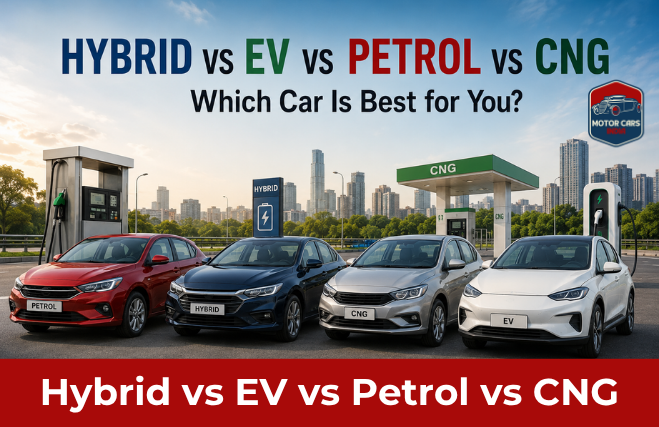
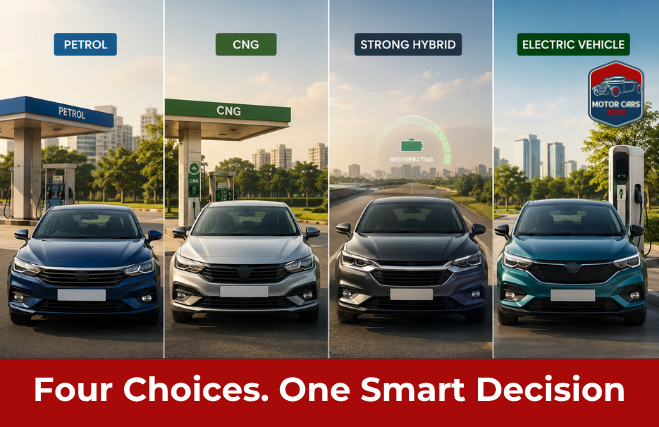
Buying a new car in India is no longer just a choice between petrol and diesel. These days, buyers can choose from petrol, diesel, CNG, hybrid or EV, each offering a different balance of performance, running cost, convenience and maintenance.
The most important question for buyers today has changed from “Which Car gives the Best Mileage?” to “Which Car will cost me less to own and use over the next five to ten years?“
Petrol cars have the advantage of easy availability and a wide variety of models to choose from. CNG cars are the most economical in terms of running costs for high-mileage users. Strong Hybrids combine a petrol engine with an electric motor without requiring external charging, whereas EVs become most economical in cost per kilometre only when charged at home.
So, Hybrid vs EV vs Petrol vs CNG – Which is more sensible for Indian Buyers? Let’s compare them.
Hybrid vs EV vs Petrol vs CNG: Quick Comparison
Factors
Hybrid
EV
Petrol
CNG
Purchase Cost
Higher
Usually Higher
Usually Lower
Moderate
Running Cost
Moderate
Very Low with Home Charging
High
Low
Refuelling/Charging
Very Convenient
Required Charging Access
Very Convenient
Depends on CNG Availability
Highway Experience
Excellent
Depends on Charger
Excellent
Good
City Experience
Excellent
Excellent
Moderate
Good
Maintenance
Higher Than Petrol
Low
Moderate
Moderate
Best Suited for
City + Highway Users
City + Highway Users with Charging Access
City Users
High Mileage Users
Which Powertrain Gives The Lowest Running Cost?
Running cost is among the most important considerations people think about when choosing alternatives to petrol.
EVs – Lowest energy cost when home charging is available.
CNG – Very economical to users covering high kilometres every month
Hybrid – Excellent fuel efficiency without depending on chargers.
Petrol – Usually the most expensive to drive among these four, but the most convenient option.
As an illustration, fuel prices may differ from one city to another and vary over time. In the case of EVs, the cost of charging at home is lower per kilometre than that of fuel. The actual cost depends on vehicle efficiency, electricity tariffs, fuel price and driving conditions.
Let’s take a simple example of 15,000 km of annual driving:
Assumptions:
Petrol mileage – 15Km/L
Petrol Price – Rs. 102/L
CNG mileage – 25Km/Kg
CNG Price – Rs. 86/Kg
Hybrid mileage – 22Km/L
EV efficiency – 7Km/kWh
Home electricity – Rs. 8/kWh
Actual mileage may vary depending on the car, traffic, driving style and road conditions.
Powertrain
Annual Cost (Approx.)
Average Cost/Km (Approx.)
Hybrid
Rs. 69,627
Rs. 4.64/Km
EV
Rs. 17,143
Rs. 1.14/Km
Petrol
Rs. 1,02,120
Rs. 6.81/Km
CNG
Rs. 52,188
Rs. 3.48/Km
Hybrid vs EV: Which is Better?
Both can offer low running costs, but through different means.
Hybrid is better if:
You frequently travel long distances
You don’t have reliable home charging
You want petrol-like refuelling convenience
You travel through areas with limited charging infrastructure.
EV is better if:
You have home charging
Most of your driving is within the city
Your daily driving is predictable
You want very low energy costs
You are comfortable planning long journeys with charging options.
Hybrids combine a petrol engine with an electric motor and battery. Strong Hybrids generally cost more than the petrol variants.
Hybrids make more sense when:
You spend a lot of time driving in city traffic
You want high fuel efficiency
You don’t want charging concerns
You regularly travel on highways
Petrol may be better when:
Your monthly running is low
The Hybrid premium is significant
You are more concerned about the initial purchase cost
Your driving style is mostly open roads/highway driving.
Winner for simplicity = Petrol
Winner for fuel efficiency = Hybrid
Petrol vs CNG: Which one Should You Choose?
CNG is a viable alternative for those who drive long distances. The biggest consideration is the cost of CNG, which needs to be kept in mind; one must also consider the availability of CNG Stations nearby.
Choose CNG if:
You drive extensively every month
Your routes have reliable CNG availability
The running cost is your priority
You do not mind long queues while refuelling
You plan to keep the car for several years
Choose Petrol if:
Your annual running is relatively low
You often drive to places where there is no CNG Station
You need more boot space where the CNG tank reduces usable space
The price of petrol variants is considerably lower.
“Don’t Look Only At Fuel Cost: Calculate Total Cost of Ownership”
The most common mistake most buyers make is comparing only mileage. The cost per kilometre for an EV will be much less than the price of buying an EV. Similarly, CNG cars may save money at the fuel station, but cost more than the same petrol variant.
Total Cost of Ownership = Purchase Cost + Financing + Fuel/Electricity Cost + Maintenance + Service Cost – Resale Value
Which Powertrain is Best for City Driving?
For heavy city use, a practical way to think is:
EV
Hybrid
CNG
Petrol
The main reason EVs might attract customers is frequent stop-and-go traffic does not create the same fuel consumption pattern as a normal petrol engine. Hybrids will also perform well in traffic because the electric motor comes into play. CNG remains the budget-focused option where CNG Stations are convenient.
Which Powertrain is Best for Highway Driving?
In case of regular highway driving, petrol and hybrid cars provide strong convenience and CNG can be a good option too.
EVs can be a great option for highways, but charging facilities and route planning become more important. A petrol or hybrid car can be refuelled in minutes, but an EV needs more charging time.
Which is Best for High Mileage Drivers?
As you drive between 20,000 to 30,000 km or more annually, running costs become increasingly important.
EVs – only if home charging is available.
CNG – only if CNG Stations are convenient
Hybrid – If you want fuel economy without charging
Petrol – If convenience and reduced initial cost are preferable to fuel saving.
The higher your annual mileage, the more important the per-kilometre cost becomes.
Which Powertrain is Best for Low Mileage Drivers
If you drive only 8,000 to 10,000 km per year, it does not make sense to pay more for an alternative powertrain.
Petrol continues to become a practical option
CNG may take longer to recover its additional initial cost
Hybrids will take time to pay off its premium price
Even though EVs’ savings will be significant, you still have to consider the extra cost of purchase.
That is why annual kilometres driven is among the first things you need to find out when choosing your powertrain.
Hybrid vs EV vs Petrol vs CNG: Pros & Cons
Hybrid
Pros:
Excellent fuel efficiency
Particularly useful in city traffic
No external charging required
Easy long-distance travel
Petrol engine backup
Cons:
High purchase price
Hybrid system complexity
Fuel savings take time to recover the initial premium
EV
Pros:
Very low energy cost with home charging
Fewer conventional mechanical components
Quiet and smooth driving
Strong city driving efficiency
No conventional engine oil changes
Cons:
Charging requires planning
Public charging can cost more than home charging
Long journeys require route planning
Battery warranty and replacement consideration
Purchase price can be higher depending on the model
Petrol
Pros:
Easy refuelling
Large selection of cars
Strong highway convenience
Established service network
Lower initial purchase price
Cons:
Higher running cost
Greater exposure to petrol price increases
More engine related maintenance
CNG
Pros:
Low running cost
Excellent for high-mileage users
Familiar engine technology
Quick refilling compared with EV charging
Cons:
CNG Station availability varies
Refilling can take longer at busy stations
Some models sacrifice boot space
Requires more conventional engine maintenance
Verdict: Which one to buy?
Hybrid vs EV vs Petrol vs CNG: there is no definite winner. The right choice depends on how you drive, where you drive and how long you wish to keep the car.
Choose Hybrid if: Fuel efficiency is essential without depending on charging infrastructure
Choose EV if: Home charging facility is available and you want the lowest energy cost for daily driving
Choose Petrol if: You want convenience, simplicity and low initial purchase cost
Choose CNG if: You wish to cover long distances and save on your monthly fuel expenditure.
The Indian passenger vehicle market is now getting more into Non-Petrol options. The relevance of alternative fuels for Indian buyers has increased, making the selection between Hybrid, EV, Petrol and CNG an increasingly important part of car buying.
For most buyers, the optimal powertrain is not the one that costs the least in terms of running costs. It is the one that offers the best balance between purchase price, running costs, maintenance, convenience and driving behaviour.
Before you make your choice, compare the on-road price, service schedule, insurance, warranty and resale value of the cars in your list.